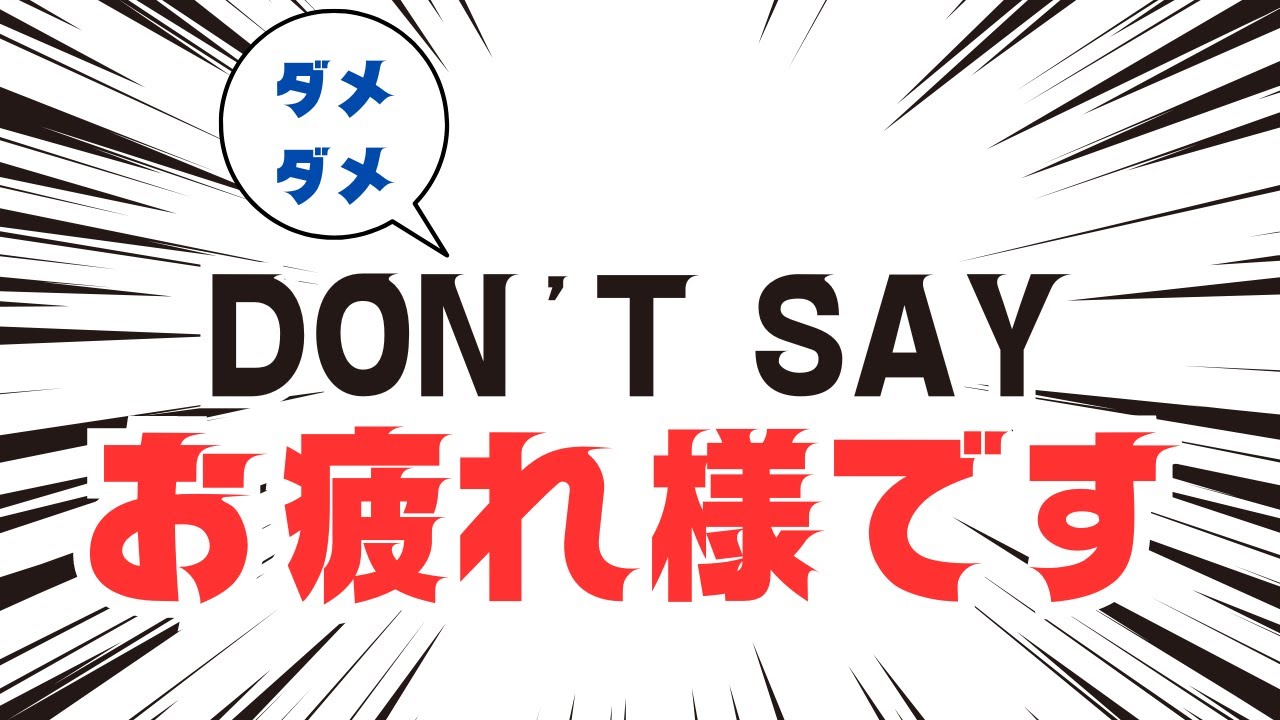
Watch the YouTube video for this article
お疲れ様です!
Although it is a very useful Japanese phrase, please do not say “otsukaresama desu” to just anyone.
“Otsukaresama desu” is a phrase often used by foreigners working in Japan.
Many people use this phrase incorrectly, so today we will explain in detail how to use “otsukaresama desu” correctly.
\ Check jobs you can apply for from overseas /
The correct way to use “Otsukaresama desu”
To put it simply, you’re using it on the wrong person.
I often talk to foreigners who want to work in Japan, and many of them say “otsukaresama desu” to me during our first interview.
There is absolutely nothing wrong with the sentence structure or grammar, and it is not rude, but Japanese people do not say “otsukaresama desu” when meeting someone for the first time.
In the first place, “otsukaresama desu” is a phrase used when speaking to people in the same company.
I say “Thank you for your hard work” to people I meet in the office.
This phrase can be used with anyone in the company, including the president, department head, or your boss.
I also often say “otsukaresama desu” to close friends, but I drop the “sama” at the end and just say “otsukare!!“
For example, Japanese people can use it like this:
Please note that “Otsukaresama desu” should only be used with people within the same company, and not with people who work at other companies, business partners, or clients.
It’s not wrong, and it’s fine to use it when meeting someone for the first time or with someone from another company, but it feels a bit strange when someone who doesn’t work at the same company says “Otsukaresama desu.”
Now, we will explain how to use this phrase when using it in a professional setting, such as when speaking to someone who works at a different company or when making a sales call for the first time, and when using it in a private setting, such as when meeting someone for the first time.
Greetings at work
Greetings to business partners and clients
「お世話になります」
「お世話になっております」を使います。
By the way, how do you use “Osewa ni narimasu” and “Osewa ni natte orimasu” differently?
「お世話になります」can be used when meeting someone for the first time.
“Osewa ni narimasu” is used when meeting someone for the first time, calling or emailing someone you haven’t met yet, or when you haven’t yet established a relationship with the other person.
「お世話になっております」This can be used when speaking with someone you know and have interacted with several times, rather than meeting for the first time.Since you already have a relationship with clients you do business with, you can use “Osewa ni natte orimasu”
In this case, too, both are grammatically correct and both are polite expressions, so it doesn’t matter which one you use.
You can use “Osewa ni natte orimasu” when meeting someone for the first time, and you can also use “Osewa ni narimasu” when speaking to a familiar client with whom you do business.
However, we Japanese use them differently.
Private greetings
When it comes to greetings outside of work/private matters, there are no specific set phrases.
Generally
「初めまして」
「こんにちは」I often use expressions such as:
In private, we don’t often use phrases like “Osewa ni narimasu” or “Osewa ni natte orimasu” when meeting someone for the first time.
If you use this phrase, people will think you’re at work and it gives off a slightly formal impression, so remember that “Osewa ni natte orimasu” is a phrase used in work situations.
In addition to greetings like “Otsukaresama desu” and “Osewa ni narimasu” there is another Japanese phrase that people often get wrong, so I’ll tell you about it as well.
\ Tips on how to get a job in Japan can be found here /
Commonly misused phrases 「○○しますか?」
Many people say “○○simasuka?” when asking someone for something, but this is incorrect.
For example, when people want me to send them something, they often ask, “okurimasuka?“
The sentence looks like this.
Also, when you want someone to ask the company you’re applying to a question through you, a common mistake is to say, “kikimasuka?”
It makes sense, but it’s grammatically incorrect.
When asking someone for something, instead of saying “○○simasuka?“,
「○○してくれませんか?」
「○○していただけますか?」(more polite)
Let’s use this.
“○○simasuka?” does not mean a request or request to the other person, but is simply a question to confirm whether I will do it or not.
In the previous example sentence,
When asked this, I end up replying, “No, you didn’t specifically ask me to, and I don’t have any plans to send one.”
In this case the correct way to say it is
By saying things like this, you can ask the other person for something because you want it.
When asking someone for something, say, “○○siteitadakemasuka?”
By the way, this phrase “Can you do ○○ please?” is a bit difficult to understand in Japanese, as it changes depending on who you’re using it with.
\ Watch the interview preparation video /
Learn how to use it correctly
When asking a subordinate or someone younger than you for a favor, you can say the following.
○○してくれない?
For example, use it like this.
Also, when asking a senior or older person for a favor, you can say the following.
○○していただけますか?
For example, use it like this.
Things to note when saying “○○sitekudasai”
“○○sitekudasai” is a polite way of saying “○○sitekurenai?”
“○○sitekudasai” is a bit of a strong expression, so it is not often used with seniors, superiors, or people of higher rank.
When someone younger than you or a subordinate says, “○○sitekudasai” it sounds like they’re ordering you around.
So when do you use “○○sitekudasai”? It is used when asking someone to do something for work purposes or when making a statement to everyone in the company, regardless of the hierarchical relationship between you and the person in question, such as a boss or subordinate.
Simply put, when the audience includes both superiors and subordinates,
more specifically, in internal meetings, group emails to the same department, or when communicating rules to everyone, you can use “sitekudasai.”
For example,
This can be used when making an announcement to everyone, rather than to a specific individual.
As such, it is necessary to use the appropriate expression depending on the person you are addressing, so please confirm who you are addressing before using it.
\ Check jobs you can apply for from overseas /
「お疲れ!今度飲み行こうよ」
「お疲れ、最近どうよ?」