Watch the YouTube video for this article
This is a question that is often asked in Japanese interviews.
You will learn how to communicate and create strengths and weaknesses that will be asked about in an interview.
There is a culture in which Japanese people are humble and foreigners emphasize their strengths and convey that they have no weaknesses, but in this course you will learn how to present yourself in a way that will be well-received by Japanese interviewers.
\ Check jobs you can apply for from overseas /
Case Study
長所と短所を教えてください。
私の長所は納期を絶対に守ることです。
クライアントの都合で納期が短縮された時も、プロジェクトチームや関係各所とスケジュールを調整しながら間に合わせてきました。そのおかげで全ての仕事において生産性が上がり、プレッシャーがかかる時でも仕事を終わらせる能力を身につけることができました。
私の短所は心配症なところです。
納期があるプロジェクトでは、納期を守りながらも質を向上させないといけないため、バグがないか、遅れはないか逐一余計に確認しています。ですが、バッファーを持てるようにスケジュールを調整したり、想定外なことが起きてもいいように下準備を完璧にしておくことで、納期内に収めることができました。
I will explain this article in more detail.
First, let me briefly state the conclusion.
Start with the conclusion, saying, “My strengths/weaknesses are __.”
Tell a story.
If you provide specific examples or results from work that support your strengths and weaknesses, your answer will be more convincing to the interviewer.
We will teach you how to make use of failure.
Instead of leaving your weaknesses as weaknesses, explain how you will utilize your strengths and weaknesses at the company you are applying to.
Points on advantages and disadvantages.
point 1: Be specific.
By providing specific examples, your strengths will be more likely to stick in the interviewer’s memory.
Point 2: Be sure to answer your weaknesses clearly.
You may want to say “I have no weaknesses” to impress the company, but everyone has weaknesses. This question tests whether you have analyzed your weaknesses.
Point 3: Finally, let them know what needs to be improved.
By not only communicating your weaknesses but also explaining how you are improving them, you will be judged as making an effort to overcome your weaknesses.
\ Tips on how to get a job in Japan can be found here /
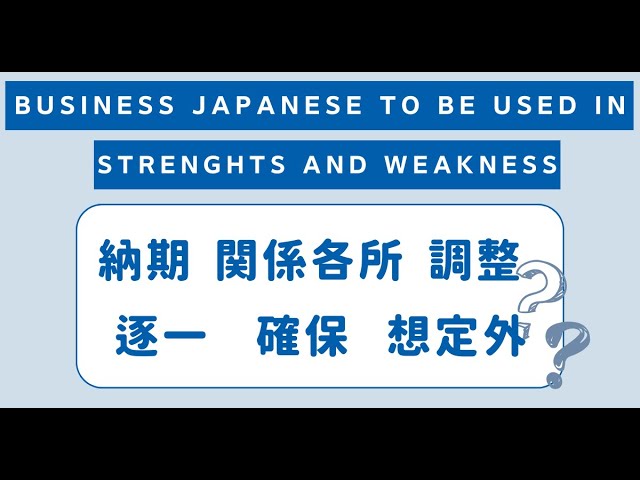
Business Japanese for Strengths and Weaknesses
Let’s review the business Japanese used in the previous example sentence, “Advantages and Disadvantages.”
納期:Deadline for delivery of goods etc.
[Example sentence]
在庫状況と納期の目安を確認します。
納期はいつ頃になりますでしょうか。
正しい納期を記した契約書を送ってください。
関係各所:People or companies related to a job
[Example sentence]
進捗について関係各所に報告する必要があります。
関係各所との協議を週末に開催する予定です。
関係各所へ予算の承認を得てください。
調整:To adjust the time and mood
[Example sentence]
予定を調整する必要はありません。
画像の位置とサイズを調整する。
機械を調整するだけで生産効率が向上する。
逐一:一つ一つすべて
[Example sentence]
上司は細かい情報を逐一教えてくれました。
何か進展があれば逐一報告してください。
逐一連絡することで仕事も円滑に進む。
確保:To protect or secure something
[Example sentence]
乗客の安全を確保する。
新に向けて人員を確保する。
商品の適正在庫を確保しなくてはならない。
想定外:exceeding the previously anticipated range
[Example sentence]
想定外の事態が発生しました。
私は想定外のことにも対処する能力があります。
想定外のことにも備えて準備をしてきましょう。
\ Watch the interview preparation video /
How to create advantages and disadvantages
When it comes to your strengths, don’t over-promote by saying “I can do this, I can do that.”
When it comes to your weaknesses, you’ll be more likely to get a job offer if you analyze them in your own way and explain how you’ve improved them.
Speaking in this order will make it easier for Japanese people to understand.
① 結論を先に伝える
Include the answer to the question or the main message you want to convey at the beginning of the sentence.
② 結論の理由を言う
Explain why you think so and how you came to that conclusion.
③ 具体例を言う
Use examples to help the other person visualize what you are saying.
④ 結論をもう一度伝える
Finally, state your conclusion or the main message you want to convey.
I will explain in more detail below.
State the conclusion first
At the beginning of the sentence, briefly state what you want to say most or answer the question. The shorter the sentence, the easier it will be to understand, so be careful not to make it too long.
In your motivation statement, explain briefly why you want to work for that company.
The important thing here is to clearly communicate, “These are the benefits you will get if you hire me.“
Give reasons for your conclusions
Next, explain why you think so. Briefly explain why your experience will allow you to contribute immediately. Keep your reasons short and logical.
In this way, by clearly communicating what experience you have and how you can use it, you can create a convincing reason.
Specific examples
After answering the interviewer’s question and giving your conclusion and reasoning, give a specific example.
Simply stating your conclusion and the reasons for it is sufficient, but if you talk about a specific example from your own experience, it will make your motivation for applying even more convincing.
Be sure to include specific examples from your own experiences.
In this way, by not only giving reasons but also telling a story that includes your own experiences, your motivation for applying will be more convincing to the interviewer.
Restate the conclusion
Finally, state your conclusion once again to conclude your talk. Just giving reasons and specific examples is fine, but it’s even better to include a conclusion or ending at the end.
The final conclusion is very simple, so let’s say it like this.
In this way, by presenting your points in the following order: 1. conclusion, 2. reasons, 3. specific examples, 4. conclusion, you will be able to speak in a way that is easy for Japanese people to understand.
\ Check jobs you can apply for from overseas /
あなたの長所と短所を教えてください。