Watch the YouTube video for this article
This is a question that is often asked in Japanese interviews.
Learn how to communicate and create reasons for changing jobs that won’t be perceived negatively. By making your reasons for changing jobs positive, you’ll be more likely to get a job offer.
\ Check jobs you can apply for from overseas /
Case Study
転職理由を教えてください。
生活水準が低く、的に生活が厳しいため転職を検討しております。
現在の月収は20万程度ですが、先輩社員の話を聞くと5年後も給料の大幅な改善や昇格が見込めない状況です。私には妻と子供がいますが、今の給料では貯金が全くできず、将来のことを考えると今の会社で働き続けるのは難しいと考え、転職を決めました。
御社では成績に応じたインセンティブや成果に見合った昇級があると伺っています。御社に入社し、売上貢献を果たすことで経済的な困難を克服し、キャリアアップを実現したいと考えております。
I will explain this article in more detail.
First, let me give you the conclusion.
Explain why you want to change jobs at the beginning of your letter. By clarifying your reasons for changing jobs at the beginning, it will be easier for the human resources staff to understand your story.
Next, let me explain the current situation.
Explain specifically why you need to change jobs. By explaining why you need to change jobs, you can make your reason for changing jobs more convincing.
Finally, explain whether the problem can be solved by changing jobs.
By explaining whether the problem can be solved by changing jobs and whether you will end up changing jobs again for the same reason, the human resources staff will be able to feel at ease in hiring you.
Here are some points to keep in mind when explaining your reasons for changing jobs.
point 1: Answer honestly.
The interviewer will understand that you are changing jobs because you were dissatisfied with your previous job, so there is no need to try and cover up or lie to hide any negative aspects.
point 2: Answer positively.
When explaining your reasons for changing jobs, be specific and logical. Even if the reason is negative, you can avoid making a bad impression by turning it into a positive choice.
point 3: Don’t complain.
Although you are changing jobs because you dislike your current job, you should never complain about it. Be careful not to say anything negative about it.
\ Tips on how to get a job in Japan can be found here /
Useful business Japanese for changing jobs
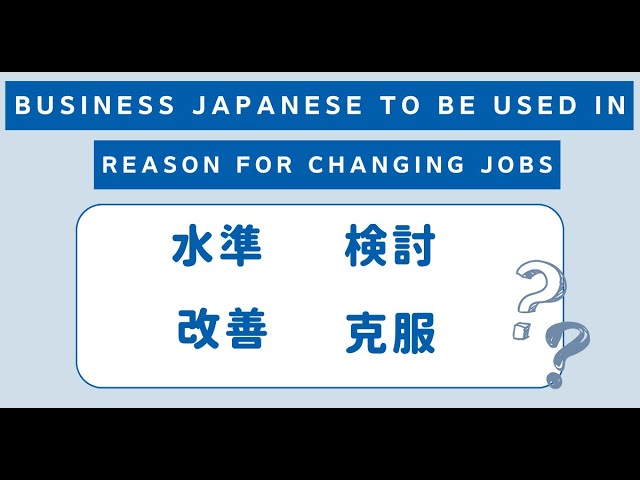
Let’s review the business Japanese used in the previous example sentence, “Reasons for changing jobs.”
水準:Standard degree or level
【例文】
給料が上がったら生活水準も上げよう。
あの国の教育水準は高いです。
彼のテニスの技術はプロの水準にある。
検討:Thinking things through carefully and determining whether they are correct
[Example sentence]
お客様のご要望について検討が必要です。
問題の解決策は検討いたします。
ご検討のほどよろしくお願いいたします。
改善:Making the bad things better
[Example sentence]
業務改善の案を出してください。
問題を改善させていただきます。
労働環境を改善するために会社へ交渉する。
克服:Overcoming difficulties
[Example sentence]
どうやってその困難を克服しましたか?
その問題を克服するために頑張ります。
弱点を克服することでレベルアップできます。
\ Watch the interview preparation video /
How to properly explain your reasons for changing jobs
When explaining why you are changing jobs, explain briefly and clearly why you left your current company and joined a new one. Try to keep your explanation to about one minute, and be careful not to make it too long.
Here too, you will make a better impression by giving a positive reason such as “I want to improve my skills” rather than a negative reason such as “There is a lot of overtime.“
Let me put it this way.
It’s easy to get caught up in negative thoughts about why you’re changing jobs, but make sure to communicate what you want to do at your new job and clearly convey to HR that it’s a positive move.
\ Check jobs you can apply for from overseas /
この会社の転職理由を教えてください。